Beer Extravaganza (Part One)
Hello everyone.
Whoa! How did I manage to go a week and a half without blogging? I knew it had been a while, but I didn't realize it had been that long. I guess I better get to it, then...
Rob (Beer) Happenings
Last week I brewed a batch of one of my most favoritest beer styles, the India Pale Ale (IPA). It was surprisingly the first time in the seven or so years I've been brewing that I've tried to brew an IPA. I don't know why that is. I love IPAs.
Fortunately, this attempt turned out better than some of my other attempts at brewing.
This particular batch is called "Ol' Deaths Whisper," and I picked up the ingredients in a conveniently pre-packaged bag from the Home Fermenter Center the last time I was in Eugene, OR. Their website appears to be down right now (which is why I linked to the Beer Advocate site instead), and I hope that doesn't mean they went out of business, because they have great brewing supplies at really reasonable prices.
This was a "partial-mash" recipe, and for those who don't homebrew, I'll explain what that means in a moment. But first, let me give you a quick rundown of the entire brewing process. You start with some barley grains that are soaked in water until they start to sprout and release a lot of sugar. The grain growth is then stopped by roasting, toasting, or some other method that usually involves a large oven of some sort, and this gives you malted barley.
When it's time to brew, you soak the malted barley (and sometimes other types of grains, depending on the recipe) in hot water, and basically make a tea out of it. Next, you get rid of the spent grains (you can feed it to livestock, or compost it, or even use it to make bread) and boil the tea down, adding hops to give it flavor as well as bitterness to balance the sweetness of the malt. This gives you an "unfermented beer" called wort. You let the wort cool to room temperature, and then add yeast to ferment the wort (lagers are fermented at lower temperatures).
Over the next few weeks or so, the yeast turns the sugars into alcohol and carbon dioxide. Once this is done, you now have beer, and all that's left to do is to carbonate it, either by bottling it with a little sugar for the yeast to eat and convert to more CO2, or by kegging it and adding carbonation from a tank. I used to be a bottling guy, but since we moved, we picked up a second fridge, and I'm now all about kegging. Cleaning and sanitizing one keg is immensely easier than cleaning and sanitizing three dozen or so bottles.
But making a "tea" out of ten, fifteen, or even twenty pounds of malted barley and/or other grains is no easy task to do in an average kitchen. There is all sorts of equipment out there to do this at home, but most of it is out of my budget at this point. Someday...
Anyway, this particular recipe is a "partial-mash," which is a small amount of specialty grains tailored to the recipe plus a large amount of malt extract, which is essentially a condensed version of the malted barley "tea." First, I extracted the "tea" from the specialty grains, in this case 3/4 lb. of amber crystal malt, and 1/4 lb. of Munich malt:

One thing brewing requires is a lot of water, and despite us having a well, our water quality isn't good. It won't make you sick, but it tastes disgusting. Maybe you like the taste of sulfur, but I don't. So I used a filter. The other problem is that we don't have great water pressure here, and when you combine that with a faucet-mount filter, the water comes out like a trickle. Seriously, I often pee bigger streams than this:

Once the grains steeped for their allotted time, it was time to rinse as much of the sugars out as possible, in a process called "sparging." I poured two quarts of 170 degree water over the grains:

I know the above photo doesn't show the hot water being poured over the grains, but I was brewing solo, and it's difficult enough to keep from spilling water and/or wort all over the kitchen, let alone trying to do so while also taking a photo. Just use you imagination.
Next, it was time to add the extract. This recipe was one of the few I've ever tried that called for both liquid and dry extracts. I don't have a photo of the dry extract, but just imagine a tannish-brownish colored Kool-Aid mix. Here's the liquid extract:

I don't like using the word, "liquid," to describe the extract, because it's not exactly liquid. It's somewhere between the consistency of honey and molasses, and it takes several rinsings with hot water to get all the stuff out of its container and into the brewing kettle. Meanwhile, you also have to keep stirring the kettle, because the extract you just added tends to immediately settle at the bottom of the pot instead of dissolving right away, and that inevitably leads to scorching. I've had some delicious smoked porters before, but I can't imagine a scorched beer to be any good.
Once all the extract is in the kettle, it's time to bring the whole thing to a boil, stirring frequently until all the extract dissolves. A nice foamy layer will form at the top:

Eventually, large bubbles will break through the foam, and that's when you know it's boiling. That means it's time to begin adding hops, starting with the bittering hops, in this case, one ounce of Chinooks. This recipe called for three different types of hops: Chinooks added at the beginning of the one hour boil, 1/2 ounce of Cascade hops (flavoring) added 40 minutes in, and 1/2 ounce of Columbus hops (aroma) added in the last five minutes. Each type of hops came in its own hop bag, which is basically a little pouch made of cheesecloth material to hold the hops in (and to easily remove them at the end of the boil):

After the boil, I ditched the hops and added some filtered cold water. I then covered the pot, set it in an ice water bath in the sink, and let it sit there until the wort dropped down to about 75 degrees. Then it was time to siphon it (some brew kettles have spigots, but mine does not, hence the siphoning) into the carboy, which is a glass container where the fermentation happens:

Once all the wort was siphoned into the carboy, I added more filtered water to make about five gallons total. The temperature was still a little warm, so I held off on adding the yeast. If the liquid is too hot (or too cold), the yeast will die on contact, and there won't be any fermentation, or at least not the good kind of fermentation. So while I waited for the wort to cool a little more, it began to settle and form cool-looking bands in the carboy:

Finally it was cool enough to add the yeast. I aerated (shook up) the carboy to get everything going. By the next morning, there was a lot of activity already. The bands were gone, and if you looked closely, you could see all sorts of movement inside the carboy as the yeast was gorging itself on the sugars. There was also a layer of foam at the top from the CO2 bubbling up. By about 24 hours in, the foam had built up pretty high and begun to work its way up the blow off tube, which is a tube attached to the carboy with the other end submerged in water, so the excess carbon dioxide can work its way out of the carboy, but fruit flies, bacteria, and other crap in the air can't find its way into the carboy and ruin the beer.
From then on, I just checked on it periodically, making sure the temperature stayed in the 65-75 degree range.
Here it is today, one week later:

It might be hard to tell from the photo, but there is still some fermentation going on. But it has already peaked out. The foam that went up the blow off tube has receded back into the carboy. A bunch of sediment has built up on the bottom. In a few days I'll check the levels, and if things look good, I'll probably siphon as much of the beer out as I can--leaving as much sediment behind as possible--into a secondary carboy, and then let it sit for another week or so. Then it will be time to siphon it out of the secondary and keg it. And in a week or so after that, if all has gone to plan, I'll have some delicious India Pale Ale on tap at home. Yay!
In Closing
I've got lots more beer news, including a report (with photos) from the beer tent at the Fall Fest at Schweitzer Mountain last weekend, as well as three new (to me) beers I've tried at home during the past week. But I've reached my blogging limit for the day, so you'll just have to stay tuned until next time.
Now here it is, your moment of Tucker (or what happens when Tucker jumps off the dock right after you do, and you don't realize he's doggy-paddling away in the water above you as you're coming up to the surface):

I think it's time to trim his nails.
Rob
Whoa! How did I manage to go a week and a half without blogging? I knew it had been a while, but I didn't realize it had been that long. I guess I better get to it, then...
Rob (Beer) Happenings
Last week I brewed a batch of one of my most favoritest beer styles, the India Pale Ale (IPA). It was surprisingly the first time in the seven or so years I've been brewing that I've tried to brew an IPA. I don't know why that is. I love IPAs.
Fortunately, this attempt turned out better than some of my other attempts at brewing.
This particular batch is called "Ol' Deaths Whisper," and I picked up the ingredients in a conveniently pre-packaged bag from the Home Fermenter Center the last time I was in Eugene, OR. Their website appears to be down right now (which is why I linked to the Beer Advocate site instead), and I hope that doesn't mean they went out of business, because they have great brewing supplies at really reasonable prices.
This was a "partial-mash" recipe, and for those who don't homebrew, I'll explain what that means in a moment. But first, let me give you a quick rundown of the entire brewing process. You start with some barley grains that are soaked in water until they start to sprout and release a lot of sugar. The grain growth is then stopped by roasting, toasting, or some other method that usually involves a large oven of some sort, and this gives you malted barley.
When it's time to brew, you soak the malted barley (and sometimes other types of grains, depending on the recipe) in hot water, and basically make a tea out of it. Next, you get rid of the spent grains (you can feed it to livestock, or compost it, or even use it to make bread) and boil the tea down, adding hops to give it flavor as well as bitterness to balance the sweetness of the malt. This gives you an "unfermented beer" called wort. You let the wort cool to room temperature, and then add yeast to ferment the wort (lagers are fermented at lower temperatures).
Over the next few weeks or so, the yeast turns the sugars into alcohol and carbon dioxide. Once this is done, you now have beer, and all that's left to do is to carbonate it, either by bottling it with a little sugar for the yeast to eat and convert to more CO2, or by kegging it and adding carbonation from a tank. I used to be a bottling guy, but since we moved, we picked up a second fridge, and I'm now all about kegging. Cleaning and sanitizing one keg is immensely easier than cleaning and sanitizing three dozen or so bottles.
But making a "tea" out of ten, fifteen, or even twenty pounds of malted barley and/or other grains is no easy task to do in an average kitchen. There is all sorts of equipment out there to do this at home, but most of it is out of my budget at this point. Someday...
Anyway, this particular recipe is a "partial-mash," which is a small amount of specialty grains tailored to the recipe plus a large amount of malt extract, which is essentially a condensed version of the malted barley "tea." First, I extracted the "tea" from the specialty grains, in this case 3/4 lb. of amber crystal malt, and 1/4 lb. of Munich malt:

One thing brewing requires is a lot of water, and despite us having a well, our water quality isn't good. It won't make you sick, but it tastes disgusting. Maybe you like the taste of sulfur, but I don't. So I used a filter. The other problem is that we don't have great water pressure here, and when you combine that with a faucet-mount filter, the water comes out like a trickle. Seriously, I often pee bigger streams than this:

Once the grains steeped for their allotted time, it was time to rinse as much of the sugars out as possible, in a process called "sparging." I poured two quarts of 170 degree water over the grains:

I know the above photo doesn't show the hot water being poured over the grains, but I was brewing solo, and it's difficult enough to keep from spilling water and/or wort all over the kitchen, let alone trying to do so while also taking a photo. Just use you imagination.
Next, it was time to add the extract. This recipe was one of the few I've ever tried that called for both liquid and dry extracts. I don't have a photo of the dry extract, but just imagine a tannish-brownish colored Kool-Aid mix. Here's the liquid extract:

I don't like using the word, "liquid," to describe the extract, because it's not exactly liquid. It's somewhere between the consistency of honey and molasses, and it takes several rinsings with hot water to get all the stuff out of its container and into the brewing kettle. Meanwhile, you also have to keep stirring the kettle, because the extract you just added tends to immediately settle at the bottom of the pot instead of dissolving right away, and that inevitably leads to scorching. I've had some delicious smoked porters before, but I can't imagine a scorched beer to be any good.
Once all the extract is in the kettle, it's time to bring the whole thing to a boil, stirring frequently until all the extract dissolves. A nice foamy layer will form at the top:

Eventually, large bubbles will break through the foam, and that's when you know it's boiling. That means it's time to begin adding hops, starting with the bittering hops, in this case, one ounce of Chinooks. This recipe called for three different types of hops: Chinooks added at the beginning of the one hour boil, 1/2 ounce of Cascade hops (flavoring) added 40 minutes in, and 1/2 ounce of Columbus hops (aroma) added in the last five minutes. Each type of hops came in its own hop bag, which is basically a little pouch made of cheesecloth material to hold the hops in (and to easily remove them at the end of the boil):

After the boil, I ditched the hops and added some filtered cold water. I then covered the pot, set it in an ice water bath in the sink, and let it sit there until the wort dropped down to about 75 degrees. Then it was time to siphon it (some brew kettles have spigots, but mine does not, hence the siphoning) into the carboy, which is a glass container where the fermentation happens:

Once all the wort was siphoned into the carboy, I added more filtered water to make about five gallons total. The temperature was still a little warm, so I held off on adding the yeast. If the liquid is too hot (or too cold), the yeast will die on contact, and there won't be any fermentation, or at least not the good kind of fermentation. So while I waited for the wort to cool a little more, it began to settle and form cool-looking bands in the carboy:
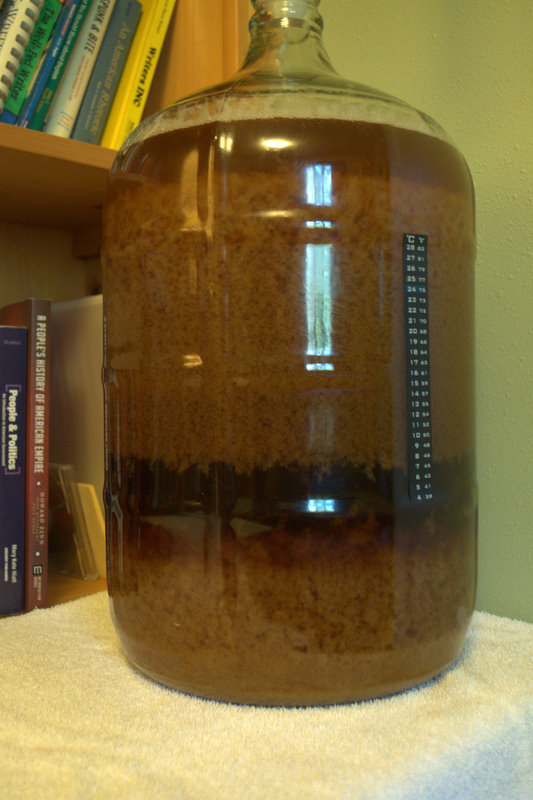
Finally it was cool enough to add the yeast. I aerated (shook up) the carboy to get everything going. By the next morning, there was a lot of activity already. The bands were gone, and if you looked closely, you could see all sorts of movement inside the carboy as the yeast was gorging itself on the sugars. There was also a layer of foam at the top from the CO2 bubbling up. By about 24 hours in, the foam had built up pretty high and begun to work its way up the blow off tube, which is a tube attached to the carboy with the other end submerged in water, so the excess carbon dioxide can work its way out of the carboy, but fruit flies, bacteria, and other crap in the air can't find its way into the carboy and ruin the beer.
From then on, I just checked on it periodically, making sure the temperature stayed in the 65-75 degree range.
Here it is today, one week later:

It might be hard to tell from the photo, but there is still some fermentation going on. But it has already peaked out. The foam that went up the blow off tube has receded back into the carboy. A bunch of sediment has built up on the bottom. In a few days I'll check the levels, and if things look good, I'll probably siphon as much of the beer out as I can--leaving as much sediment behind as possible--into a secondary carboy, and then let it sit for another week or so. Then it will be time to siphon it out of the secondary and keg it. And in a week or so after that, if all has gone to plan, I'll have some delicious India Pale Ale on tap at home. Yay!
In Closing
I've got lots more beer news, including a report (with photos) from the beer tent at the Fall Fest at Schweitzer Mountain last weekend, as well as three new (to me) beers I've tried at home during the past week. But I've reached my blogging limit for the day, so you'll just have to stay tuned until next time.
Now here it is, your moment of Tucker (or what happens when Tucker jumps off the dock right after you do, and you don't realize he's doggy-paddling away in the water above you as you're coming up to the surface):

I think it's time to trim his nails.
Rob
posted by Rob at 3:21 PM
0 comments